PCB Box Build Assembly Services: From PCB Assembly to Complete Product Manufacturing
1. Why Buyers Are Moving from PCB Assembly to Full Box Build Assembly
With the accelerated iteration of electronic products, many OEMs now prefer to choose PCBA suppliers that can provide one-stop “design-manufacturing-assembly” services in order to cope with shortened R&D cycles and market competition pressures.
(1) From Decentralized Procurement to One-Stop Delivery
In the traditional model, companies need to handle multiple stages such as PCB design, board manufacturing, surface mount technology (SMT), and testing separately, resulting in high communication costs and long cycles. However, OEM (Original Equipment Manufacturer) service providers can integrate resources across the entire circuit board manufacturing process to achieve:
- Reduced multi-party coordination, improving response speed
- Simultaneous circuit design and manufacturability analysis, shortening development time
- Automatic scheduling of production resources based on order priority, improving on-time delivery rate
This model is particularly suitable for small-to-medium batch and highly complex PCB board production projects
According to reports, PCBA manufacturers with full-process service capabilities will occupy more than 60% of the prototyping and small-batch market.
(2) Increased Technological Barriers
Modern electronic products place increasingly higher demands on PCB performance, such as high-frequency and high-speed signal processing, high-density wiring, and thermal management. This leads to:
- The need for professional simulation tools (such as high-speed simulation and thermal analysis)
- High-end products such as HDI, packaging substrates, and 800G optical modules have extremely high requirements for PCB board manufacturing process precision
- Multilayer boards and fine-pitch components are prone to soldering defects and warping problems
If companies build their own production lines, they need to invest a lot of capital and talent; while choosing a professional OEM can directly utilize their technological accumulation and equipment advantages, reducing trial and error costs.
(3) Changes in Cost Structure Make The Complete Machine More Cost-effective
Considering the following factors, assembling the turnkey box build PCB assembly services is actually more economical:
- Full box build manufacturing manufacturers purchase components in bulk, obtaining lower purchase prices.
- No need to prepare materials themselves, reducing inventory pressure.
- Reduced defect rate losses to reduce rework and scrap.
- No need to equip a dedicated engineering and production team.
Industry data show that integrating box build electronics manufacturers can reduce production coordination time by 20% to 35% and shorten the overall product launch cycle.
2. What Is PCB Box Build Assembly?
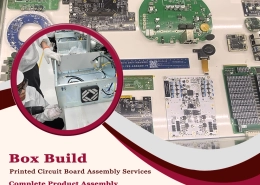
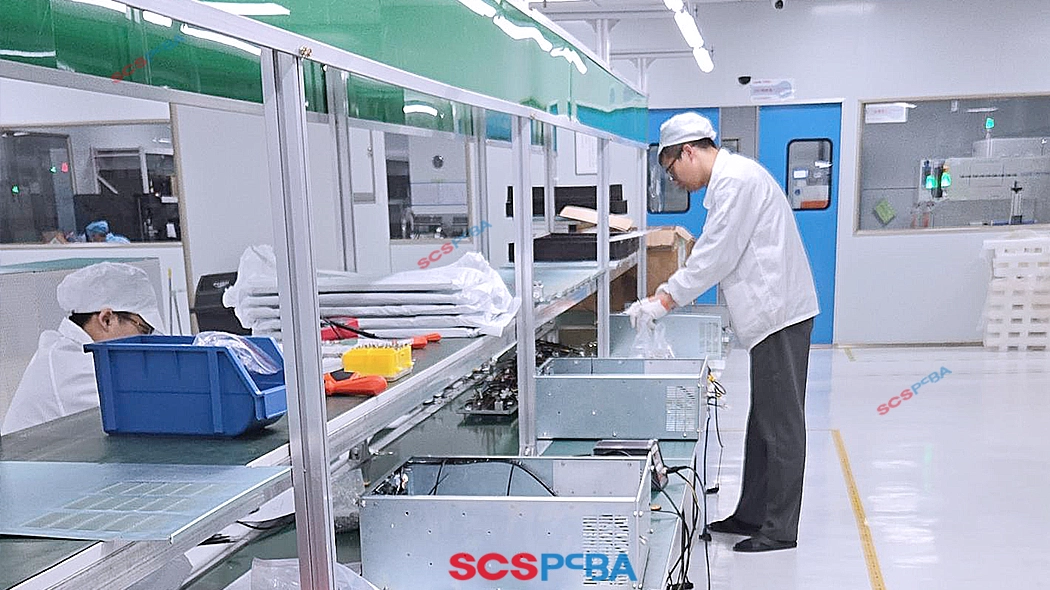
Box-build assembly refers to the process of integrating the assembled circuit boards into a complete product casing after PCB assembly, and then integrating them with other mechanical components, cables, power supplies, displays, and other components to form a complete electronic device that can operate independently. It is not only the final stage of manufacturing, but also a key link in realizing product functionality and deliverability.
Typical electronic box build assembly includes:
- Structural assembly
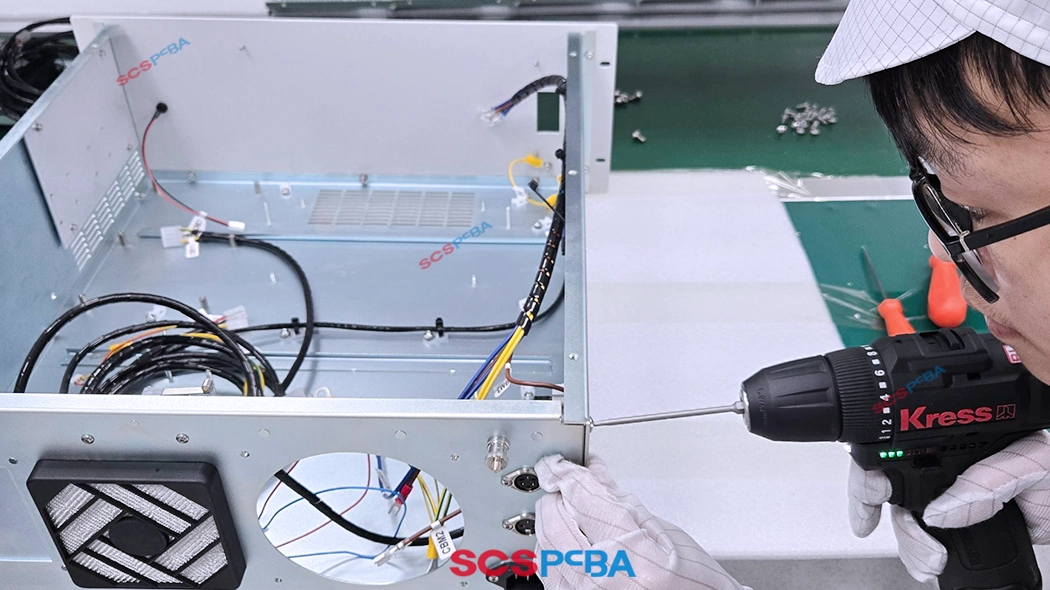
Securely attaching the PCBA to the chassis or enclosure using screws, clips, etc. - Wiring harness connection
Connecting power cables, signal cables, buttons, interface panels, and other peripheral components. - Component integration
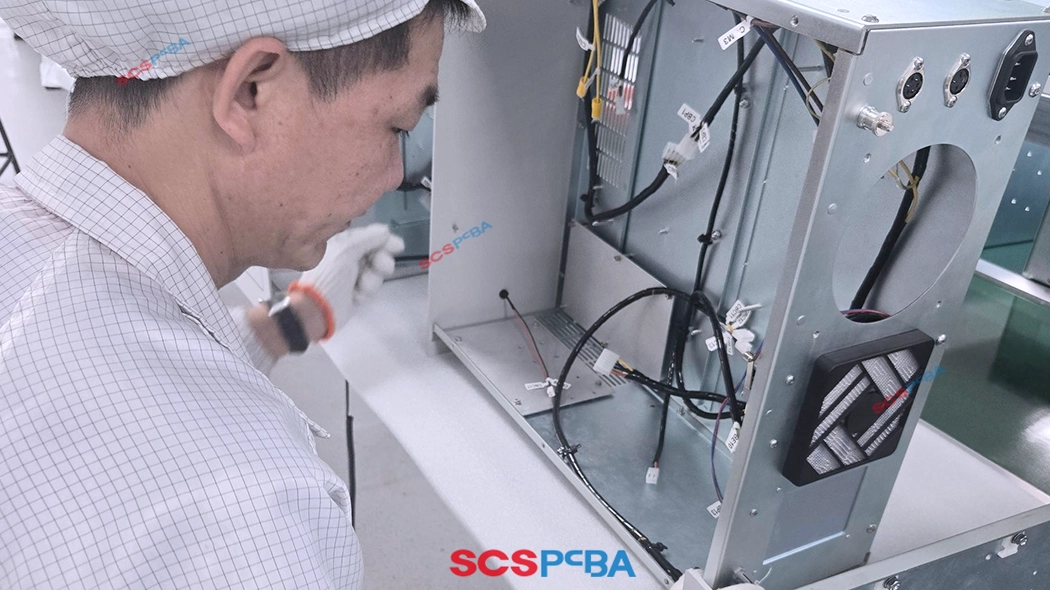
Installing non-PCB components such as cooling fans, displays, button panels, and sensors. - System-level testing
Verifying the system’s power-on performance, functional operation, temperature rise, EMC, and other performance characteristics. - Packaging and labeling
Labeling, barcode scanning, anti-static packaging, and preparing for shipment.
SCSPCBA’s goal is to deliver fully functional products, not just a circuit board
3. PCB Assembly vs Box Build Assembly — What’s the Difference?
| Aspect | PCB Assembly | Box Build Assembly |
|---|---|---|
| Output | Assembled PCB | Finished product |
| Mechanical integration | ❌ | ✅ |
| Cable & harness | ❌ | ✅ |
| Functional system test | Limited | Full system test |
| Packaging | No | Yes |
| Supply chain complexity | High | Reduced |
| Responsibility ownership | Split | Unified |
PCB assembly focuses on electronics manufacturing, while box build assembly ensures system-level reliability
4. Box Build Assembly Cost Breakdown — Where Your Budget Goes
(1) Material Costs: 50%-80% of total cost
This is the cornerstone of PCBA cost, directly dependent on the components and PCB materials listed in the BOM.
- PCB Bare Board Costs
- Materials Type: Ordinary FR-4 costs approximately 0.3-0.8 RMB per square centimeter; high-frequency Rogers materials can reach 2-5 RMB.
- Layer Count and Process: Double-sided vs. four-layer boards double the price; 12-layer boards or HDI boards significantly increase cost.
- Size and Special Processes: Blind vias, impedance control, immersion gold plating, etc., will incur additional costs.
- Electronic Component Costs
- Passive Components (Resistors, Capacitors, Inductors): Low unit price but high usage, accounting for 20%-30% of material costs.
- Active Components (MCUs, Chips, Sensors): High unit price, the “biggest” cost, accounting for 50%-60%.
- For example, a single 5G chip can account for over 40% of the total material cost.
(2) Production and Processing Costs: 15%-25% of total costs
This includes SMT (Surface Mount Technology), DIP (Digital Integrated Circuit) insertion, and soldering processes. Costs are strongly correlated with the complexity of the printed circuit board manufacturing process.
- SMT Insertion Costs
- By Solder Joint: Ordinary solder joints: 0.008-0.015 RMB/joint; BGA ball joints: 3-5 joints.
- Start-up/Engineering Fees: Includes programming, stencil fabrication, and first article confirmation; significant cost amortization for small batches.
- DIP Insertion and Post-Soldering
- High reliance on manual labor: 0.05-0.5 RMB/unit; labor costs can reach 40% for small batches.
- Automated Wave Soldering: Approximately 1-5 RMB per board; suitable for large batches.
- Special Process Surcharges
- QFN packaging requires nitrogen protection; 2-5 RMB extra per board.
- Encapsulation is charged by volume, 0.5-2 RMB per milliliter.
(3) Engineering and design costs: accounting for 10%-20% of total costs
- DFM manufacturability analysis: optimizing PCB layout design to reduce production risks
- Steel mesh fabrication: initial mesh production costs
- Sample prototyping engineering fees: equipment debugging, program writing, and small-batch trial production all require fees
Small-batch PCB production orders have significantly higher unit costs than mass production due to the high proportion of engineering costs allocated to them.
(4) Inspection and Testing Costs: 5%-10% of Total Cost
Different inspection methods correspond to different cost tiers.
- Basic Inspection
- AOI Optical Inspection: checks for mounting and soldering defects.
- ICT Continuity Testing: verifies electrical continuity.
- Advanced Inspection (Select as needed)
- X-ray Inspection of BGA Internal Solder Joints
- FCT Functional Testing: Requires customized fixtures, commonly used for high-reliability products.
- High-Requirement Scenarios:
- Automotive electronics, medical equipment require conformal coating and high/low temperature cycling testing; inspection costs exceed 10%.
(5) Other Ancillary and Hidden Costs
- Auxiliary Material Costs: Solder paste, cleaning agents, UV adhesive
- Packaging and Logistics: Anti-static bags, foam, pallets; costs differ for same-city express delivery, inter-provincial logistics, and international logistics
- Waste and Profit Margin: Typically, a 3%-5% allowance is made for material waste; electronics box build assembly factory profit margins are 10%-30%.
5. Engineering-Controlled PCBA Box Build Solutions Process
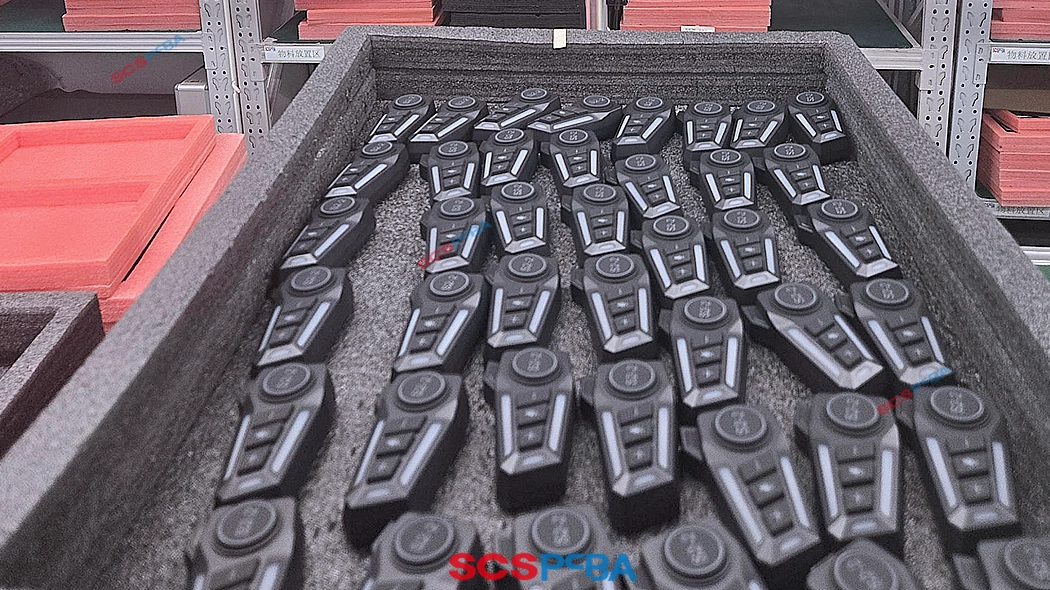
PCB box assembly is a crucial step in transforming a product from a “functional circuit board” to a “deliverable complete system,” involving multiple verifications of structure, electrical systems, functionality, and reliability.
(1) Pre-assembly Preparation Checks
- PCBA incoming material confirmation
Check the PCBA version number and batch number. All components must provide batch traceability codes. Confirm that there is no physical damage, oxidation, or residue. - BOM and assembly drawing matching
Confirm that the bill of materials (BOM) and assembly drawings used for the current assembly are the latest controlled versions. - Shell and structural component integrity
Check that the casing is free from deformation, burrs, and color difference. Check that the buckle/screw hole positions match. - Accessory completeness
Confirm that cables, buttons, fans, displays, and other non-PCB components are complete and of the correct model. - Static electrostatic protection measures in place
The workbench is properly grounded, and operators wear anti-static wrist straps.
(2) Structural and Mechanical Assembly Inspection Items
- PCBA Fixing Method Compliance
Use appropriate screws/clips to avoid overtightening that could cause PCB cracking or stress concentration. - Heat Dissipation Design Implementation
High-heat components (such as power modules) have heat sinks installed, and thermal expansion gaps have been provided. - Height Limit Compliance
The tallest component on the board maintains a safe distance of ≥2mm from the top of the casing. - Accurate Interface Alignment
External interfaces such as USB, network ports, and buttons are precisely aligned with casing openings without obstruction. - Shielding Cover Installation
High-frequency or EMC-sensitive areas have been fitted with metal shielding covers and reliably grounded.
(3) Cable and Electrical Connection Inspection Items
- Correct and Accurate Wiring Harness Connections
Power cables, signal cables, and ribbon cables are connected in the correct direction and polarity, with no risk of reverse connection. - Secure Terminal Crimping
Special tools are used for crimping; there are no exposed copper wires or loose terminals. - Neat and Standardized Cable Routing
Cables are kept away from high-temperature/moving parts and secured with cable ties to prevent tensile stress from being transmitted to the solder joints. - Grounding Continuity Verification
The continuity resistance between the chassis grounding terminal and the PCBA ground plane is <0.1Ω. - High-Voltage Area Isolation
High-voltage and low-voltage lines are separated, and the spacing meets safety regulations
(4) Controlled Assembly Environment – The Invisible Guardian of Quality
The sensitivity of the environment to one-stop box build PCBA manufacturing far exceeds that of PCB manufacturing. Temperature and humidity, cleanliness, and electrostatic discharge protection constitute the three lifelines:
| Control Dimensions | Standard Parameters | Implementation Requirements |
|---|---|---|
| Temperature | 22 ± 2℃ | Precision assembly area temperature control, fluctuation ≤ ±1℃/h |
| Humidity | 45 ± 5% RH | To prevent static electricity buildup and avoid component failure due to moisture absorption |
| Cleanliness | ISO Class 8 | ≥0.5μm particles ≤3,520,000/m³; three-stage filtration system |
| Illumination | Precision range 750–1000 lux | Ensure no part of the visual inspection is missed to avoid misassembly |
| Antistatic Discharge (ESD) | Three-Level Protection System | 1. Antistatic work surface (resistance 10⁶–10⁹Ω)
2. Personnel wearing wrist straps (grounding resistance 1MΩ) 3. Hand disinfection and wearing antistatic clothing every 2 hours. |
| Ground and Equipment | “Three-Free” Standard | Dust-free, oil-free, and water-free; equipment surface particle residue ≤100μg/100cm² |
Prohibited behaviors: Entering the assembly area without wearing anti-static clothing, using ordinary plastic trays, and unpacking sensitive components in non-clean areas.
(5)Functional Testing Box Build Assembly
| Test Category | Test Content | Pass Criteria | Tools/Equipment |
|---|---|---|---|
| Power-on self-test | Instantaneous current and voltage surge upon power-on | No short circuit, no smoke, no abnormal noise | Power load test |
| Basic Function Verification | Button Response, LED Indicators, Display On, Bluetooth/WiFi Connectivity | 100% Function Activation | Automated Test Fixture (FCT) |
| Power Supply Performance | Output Voltages (3.3V/5V/12V) | Fluctuation ≤ ±5% (Full Load) | Digital Multimeter + Load Simulator |
| Temperature Rise Test | Continuous full-load operation for 30 minutes | Key chip temperature rise ≤40℃, casing temperature ≤60℃ | Infrared thermal imager |
| EMC Pre-Compliance |
Radiated Emissions (RE), Conducted Interference (CE) | Passed CISPR 32 Class B initial screening | EMC Receiver |
| Safety Interlocks |
Emergency stop button, light curtain, and access control trigger | Response time ≤ 50ms, system immediately power off | Safety PLC tester |
| Communication Interfaces | USB, Ethernet, RS485; Bit Error Rate | Bit Error Rate < 10⁻⁹ | Signal Analyzer |
(6) Final Inspection and Packaging Checklist
- Clean and stain-free appearance
No fingerprints, flux residue, or scratches on the entire surface. - Complete and clear labeling
Model label, serial number, and certification marks (e.g., CE, FCC) are affixed. - Complete conformal coating
Conformal coating has been applied evenly without bubbles or missed areas. - Adequate packaging and protection
Anti-static bag + foam lining is used; the outer box is marked “Fragile” and indicates the handling direction.
(7) Documentation and Traceability Checklist
- Production Batch Records Complete
PCBA, casing, and key components are all traceable to suppliers and production dates. - Test Report Archiving
FCT test logs are retained for each unit or sampled complete units. - Change Management Closed Loop
In case of engineering changes (ECN), relevant documents have been updated and upstream and downstream partners have been notified.
6. Smart Online Quotation Platform for Box Build Projects
One major difficulty in box build projects is quoting complexity.
Costs involve electronics, mechanical parts, labor, and testing simultaneously.
SCSPCBA’s intelligent online quotation platform addresses this by:
(1) Engineering-Based Cost Modeling
The system evaluates:
- PCB assembly complexity
- Mechanical assembly steps
- Cable and accessory integration
- Testing requirements
- Production volume scaling
(2) Automatic Volume Optimization
The box-built PCBA services quote platform dynamically adjusts:
- Assembly labor estimation
- Testing strategy
- Supply chain sourcing options
- Buyers can compare prototype, low-volume, and mass production pricing under the same logic.
Get a BOM Quote for Your Box Build Project
7. When Should You Choose Box Build Assembly?
When products are involved in the following areas, turnkey box build assembly are particularly important:
(1) IoT devices: small batches, multiple categories, high integration
IoT terminals are generally small in size, multifunctional, and rely on wireless communication, requiring the integration of sensors, MCUs, antennas, and power management modules within a very small space. Box build assembly manufacturer can offer:
- HDI and flexible PCB (FPC) technology support for compact layout
- Automated dispensing and weatherproofing to improve the weather resistance of outdoor equipment
- Wireless performance tuning services (such as antenna matching testing)
(2) Industrial Control Box Build Assembly
Industrial environments present challenges such as vibration, high temperatures, and electromagnetic interference. The assembly of the complete unit must ensure:
- Mechanical fixation to prevent loosening (e.g., using spring washers, thread-locking adhesive)
- Separate wiring for strong and weak current circuits, meeting safety regulations regarding spacing
- Passing EMC Level 3 or higher certification testing (e.g., IEC 61000-4)
A reliable box build assembly manufacturer typically equip themselves with aging chambers and vibration test benches to simulate harsh operating conditions before delivery and expose potential hazards in advance.
(3) Smart Consumer Electronics
From headphones to smartwatches, consumer electronics emphasize both aesthetics and seamless functionality. The value of custom electronic box build assembly services lies in:
- Precision component assembly (e.g., waterproof ring lamination, curved screen bonding)
- Automated testing processes (FCT fixtures cover all user interaction scenarios)
- Rapid response to design changes (supporting small-batch flexible production)
(4) Medical Electronics Turnkey Box Build
Medical devices place extremely high demands on the reliability of their PCBAs, as any failure can be life-threatening. The entire assembly must meet the following requirements:
- ISO 13485 Quality Management System Certification
- Use of biocompatible materials (e.g., halogen-free conformal coatings)
- Traceability management (each PCBA is associated with the device’s serial number)
- For example, a portable ECG monitor needs to integrate a high-precision analog front-end and Bluetooth module within a limited space, and the entire medical device must be FDA or CE certified.
(5) Automotive Control Unit Box Build Manufacturing
Automotive electronics face temperature variations ranging from -40°C to 125°C, continuous vibration, and high humidity environments. Special attention is required during assembly:
- Use automotive-grade components (AEC-Q certified)
- Add vibration damping pads and thermal grease to key components
- Comply with ISO 16750 road environment testing standards
For example, ADAS radar modules need to remain stable under high-frequency signal transmission; assemblers must have millimeter-wave testing capabilities.
8. One box build assembly Manufacturing Partner from PCB to Finished Product
The most effective manufacturing strategy today is not managing multiple vendors but working with a partner capable of supporting:
- Prototype validation
- Pilot production
- Volume manufacturing
- Finished product assembly
A unified manufacturing model preserves engineering knowledge and ensures process continuity throughout the product lifecycle.
Get a BOM Quote
Talk to an Engineer About Your Box Build Assembly Project
Latest News
 Box Build Printed Circuit Board Assembly Services | Complete Product AssemblyFebruary 25, 2026 - 1:00 am
 PCB Assembly from Prototype to Mass Production: Solving Volume Challenges for ODM/OEMFebruary 10, 2026 - 1:00 am
 PCB Assembly Testing & Inspection: Building Trust Through Measurable Quality ControlFebruary 5, 2026 - 1:00 am
 From Prototype to Mass Production: Consumer Electronics PCB AssemblyJanuary 30, 2026 - 1:00 am
 Industrial Control PCBA Solutions With Strict DFM and MES ControlJanuary 25, 2026 - 1:00 am